
The Terrifying Sensation of a Disappearing Brake Pedal
Charging toward Turn 1 with the car loaded under heavy braking is one of the defining sensations of a track day. It is also the moment when a hydraulic problem becomes genuinely frightening. A pedal that suddenly travels farther than expected, feels spongy, or drops almost to the floor is not a minor handling complaint. It can mean that the brake fluid has produced vapor inside the system, turning a normally firm hydraulic circuit into a compressible one precisely when maximum stopping force is required.
Many track preparations focus on pad compound, rotor condition, and the dry boiling point printed on a fluid bottle. Those checks matter, but the headline number describes fresh fluid in controlled conditions, not fluid that has spent months exposed to humid air and repeated heat cycles. The thermodynamic cascade is straightforward: heat enters the caliper through the pads and pistons, moisture lowers the fluid’s boiling threshold, vapor bubbles form, and pedal movement is spent compressing gas instead of moving the pistons. Understanding that chain is more useful than chasing the largest catalog number.
The Physics of Brake Fluid Boiling and the Wet versus Dry Dilemma
The dry boiling point is the temperature at which fresh, uncontaminated fluid, taken from a properly sealed container, begins to boil under a standardized test. It is the impressive number typically used in performance marketing. A racing DOT 4 fluid may show a very high dry equilibrium reflux boiling point, and that can provide valuable thermal margin during short, intense sessions. However, the number begins to lose relevance as soon as the fluid is opened and installed in a working vehicle.
The wet boiling point represents fluid containing approximately 3.7 percent water by volume, the standardized condition used to show how a glycol-based fluid performs after moisture contamination. Water enters gradually because common DOT 3, DOT 4, and DOT 5.1 fluids are hygroscopic, meaning they absorb moisture from the atmosphere. Flexible rubber hoses, reservoir vents, caliper seals, and microscopic gaps around service connections all provide pathways for humidity. Temperature cycling accelerates the process, so a car that sees hot track sessions can age its fluid by heat exposure as well as by calendar time.
Federal safety standards establish minimum performance requirements for commercial brake-fluid grades, but those minimums are not the same as a competition setup. The official Federal Register portal is useful when checking the underlying regulatory material; if access is restricted while reviewing it, Request Access can help, although a track car needs a more demanding maintenance strategy than a street vehicle merely meeting the legal baseline.
| Condition | What the number represents | Practical meaning |
|---|---|---|
| Dry boiling point | Fresh fluid with negligible water contamination | Useful for comparing initial thermal capacity, but not a service-life guarantee |
| Wet boiling point | Fluid containing approximately 3.7 percent water | More representative of aged fluid in a working vehicle |
| Regulatory minimum | Performance required for the labeled DOT classification | Protects ordinary road use, but may offer limited margin during repeated track braking |
| Motorsport requirement | High temperature margin, correct viscosity, and disciplined replacement | Must be matched to the car, ABS system, climate, and session format |
Molecular Chemistry of Modern Glycol Formulations
Most modern performance brake fluids are based on polyalkylene glycol ethers, blended with additives that control corrosion, lubricity, oxidation, seal compatibility, and viscosity. High-performance DOT 4 products may also use borate ester chemistry to increase boiling resistance. The formulation is a compromise rather than a single-purpose race ingredient. A fluid must remain stable at the caliper, move through narrow passages, protect steel and aluminum components, and avoid swelling or damaging elastomer seals.
DOT 5.1 is also glycol-based, despite its number, and should not be confused with silicone DOT 5. Its major advantage is often lower kinematic viscosity, particularly at low temperatures. That characteristic can help modern ABS, electronic stability control, and traction-control modulators react through very small internal passages. Racing DOT 4, by contrast, commonly prioritizes the highest possible thermal threshold. The right choice depends on whether the car needs rapid cold-flow response, exceptional repeated-session heat resistance, or a balanced combination of both.
- DOT 3 and conventional DOT 4: Suitable for many road cars when the manufacturer approves them, with useful corrosion protection and predictable service behavior.
- DOT 5.1: Glycol-based and often selected for low-temperature viscosity and ABS compatibility, but still hygroscopic.
- Racing DOT 4: Designed for high heat and hard use, usually requiring more frequent replacement because performance depends heavily on fluid condition.
- DOT 5: Silicone-based, generally not interchangeable with glycol fluids and often unsuitable for modern ABS or stability-control systems.
The hygroscopic trap is especially important with aggressive racing formulations. A fluid engineered to achieve an exceptional dry boiling point may absorb atmospheric humidity readily, and that moisture can reduce the effective boiling margin faster than expected. Silicone-based DOT 5 avoids the same type of water absorption, but it introduces different concerns, including aeration, compressibility, and compatibility with systems designed around glycol fluid. Never substitute DOT 5 simply because its label appears to solve a moisture problem.
Diagnostic Field Guide for Distinguishing Fluid Vapor Lock from Pad Glaze
Start with the pedal, not the brake hardware. Hydraulic vapor lock usually produces a sudden change in pedal travel. The pedal may feel soft, sink unusually far, or improve temporarily after several pumps and a cooling period. That recovery is a major clue: vapor bubbles can condense as the fluid cools, restoring some firmness, but the underlying fluid remains compromised. Heat distribution can also reveal the problem. A caliper that has transferred extreme heat into the fluid may show a hotter body or localized discoloration near the piston area, even when the pad surface looks acceptable.
Pad fade is different. Friction material fade typically leaves the pedal relatively firm because the hydraulic system is still generating pressure. The car simply fails to decelerate as expected. Glazed or overheated pads can feel unusually hard at the rotor, provide weak initial bite, and produce a sharp resin or friction-material odor. As documented in a brake overheating discussion, odor alone does not prove a failure, but reduced braking performance must be treated as dangerous. Higher-temperature fluid will not restore friction that has been destroyed by an unsuitable pad compound or excessive rotor temperature.
- Secure the car and stop driving hard. If the pedal reaches the floor or braking performance is seriously reduced, leave the racing line and return to the paddock only at a controlled speed, using engine braking where possible.
- Check pedal behavior after cooling. A firm pedal with poor stopping power points toward pad or rotor friction loss. A soft, pumpable pedal points toward air or vapor in the hydraulic circuit.
- Inspect for leaks. Examine caliper bleed screws, hose connections, banjo fittings, the master-cylinder area, and the inside of each wheel before assuming the fluid simply boiled.
- Inspect pad surfaces. Look for glazing, crumbling edges, discoloration, uneven transfer layers, or friction material that has separated from its backing plate.
- Measure and compare temperatures carefully. Infrared readings can be misleading on shiny surfaces, but large left-to-right differences may identify a dragging caliper, blocked hose, or uneven pad contact.
- Bleed or flush before the next session. Do not treat repeated pedal pumping as a repair. It can temporarily mask vapor, while the next braking zone may recreate the failure.
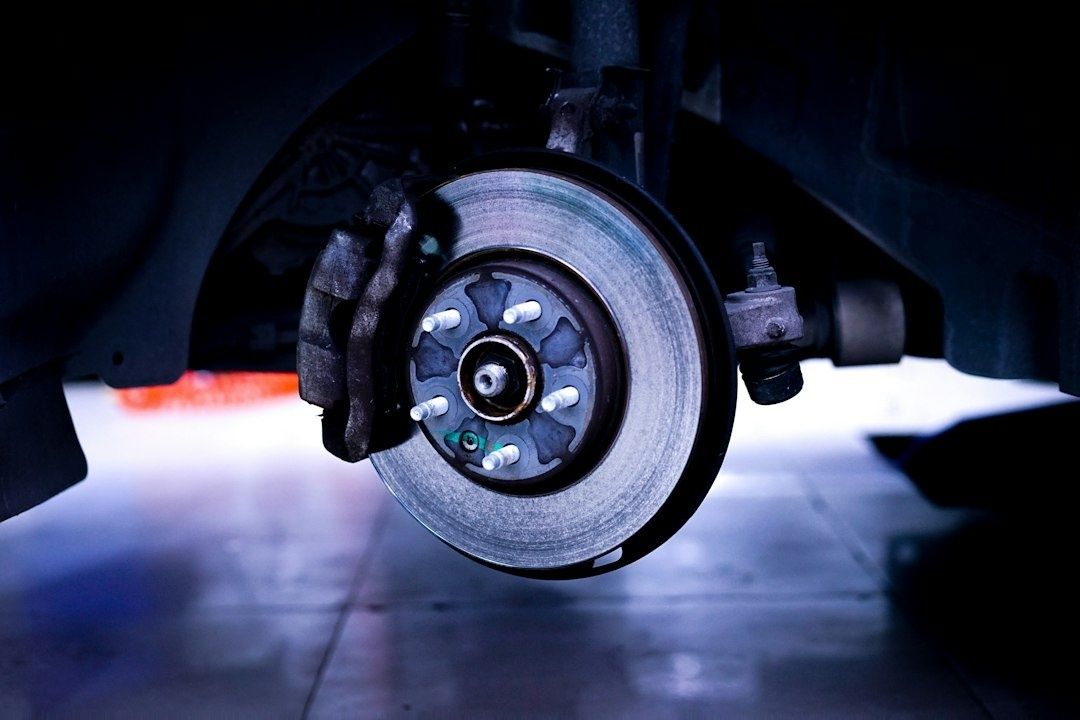
Heat reaches the fluid mainly through conduction. The pad heats the piston, the piston transfers energy into the caliper body and seals, and the fluid in the caliper cavity absorbs that heat. This is why a large rotor alone cannot guarantee a safe pedal. Cooling airflow, piston design, pad backing plates, caliper insulation, fluid volume, and session length all influence the final temperature at the hydraulic circuit.
Strategic Fluid Selection and Trackside Maintenance Protocols
Choose fluid by duty cycle rather than by the highest dry boiling point. A heavy vehicle on a fast circuit, running long sessions with little cooling time, demands more thermal margin than a lightweight car on a short technical track. A car with a sophisticated ABS and stability-control system may need a low-viscosity fluid approved for the system, while a simple competition car may benefit more from a high-temperature racing DOT 4. Always begin with the vehicle manufacturer’s specification and confirm compatibility before changing fluid type.
Federal requirements define the performance benchmarks attached to DOT brake-fluid grades, including boiling behavior and other safety characteristics. The authoritative technical standard should be treated as the reference point for the legal classification, not as a substitute for track preparation. A fluid can comply with a DOT grade and still be the wrong choice for a particular ABS unit, seal package, or race schedule.
- Frequent track use: Plan a complete fluid replacement about every six months, and sooner if the fluid has experienced repeated boiling, contamination, or severe heat cycles.
- Occasional track use: Flush before the event if the service history is uncertain, even when the calendar interval appears acceptable.
- Road-only use: A two-year interval is a common practical target when it agrees with the vehicle manufacturer’s schedule and the system remains leak-free.
- After suspected vapor lock: Replace the fluid rather than simply bleeding a small quantity from each corner.
Trackside bleeding requires patience. Use fresh fluid from a sealed container, keep the reservoir from running dry, and follow the vehicle-specific wheel sequence. Open the bleed screw only enough to produce a controlled flow, close it before the pedal is released when using a two-person method, and watch for tiny bubbles rather than waiting only for a dramatic air pocket. Localized micro-bubbles can remain near the caliper bleed screw or in high points of the line. Several short bleed cycles, gentle caliper tapping where appropriate, and an ABS service procedure may be necessary on systems that trap air inside the modulator.
Bleeding removes air or a limited amount of contaminated fluid. Flushing replaces the old fluid throughout the circuit. That distinction matters because a small bleed at the caliper may leave moisture-laden fluid in the master cylinder, ABS block, and flexible lines. After service, confirm a firm pedal with the engine off, then check pedal behavior with the engine running and the vacuum assist active. Any continuing softness, fluid loss, warning light, or uneven brake response requires a proper workshop diagnosis before returning to the circuit.
Build a Bulletproof Braking System Before Your Next Session
The dry boiling point is a useful starting measurement, not a promise of track reliability. Once fluid has absorbed water, its wet boiling performance becomes the relevant concern. A disciplined driver therefore treats fluid age, humidity, caliper heat, pad selection, cooling, and session length as one connected system. The strongest racing fluid cannot compensate for neglected bleeding, a leaking hose, glazed pads, or an ABS unit containing trapped air.
- Verify the fluid specification and confirm compatibility with the vehicle’s ABS and stability-control system.
- Inspect the reservoir, hoses, calipers, bleed screws, fittings, and master-cylinder area for leaks or staining.
- Check pad thickness, surface condition, backing-plate integrity, and rotor cracks or severe heat checking.
- Flush with fresh fluid at the correct interval, especially before a major event or after any suspected boil.
- Bleed all circuits methodically and confirm that the pedal remains firm after repeated applications.
- Use engine braking and cooling laps to manage total brake energy instead of relying on the pedal continuously.
- Stop the session immediately if the pedal changes unexpectedly or stopping performance falls away.
A dependable brake pedal is more than a maintenance detail. It is the foundation for accurate threshold braking, consistent corner entry, and the confidence to use the car’s available grip without guessing what will happen next. Build that confidence through fluid condition and system discipline, then let the performance hardware do its job.

